

Buy High Elevation Specialty Coffee Beans: 2026 Guide
Table of Contents
- Why Buy High Elevation Specialty Coffee Beans in 2026
- The 10 Best High Altitude Coffee Beans: Side-by-Side Comparison
- Coffee Growing Altitude and Flavor: What the Numbers Actually Tell You
- Single Origin High Elevation Coffee: Picking the Right Estate for Your Cup
- Freshly Roasted Specialty Coffee Beans: Why Roast Date Beats Everything Else
- How We Scored These Beans: Elevation, Freshness, and Cupping Notes
- Brewing High-Grown Coffee by Method: Espresso, Pour-Over, and Milk Drinks
- Choosing Your Bag: A Decision Framework Before You Check Out
- Frequently Asked Questions
Last Updated: October 21, 2026
Why Buy High Elevation Specialty Coffee Beans in 2026
Altitude is the most reliable shortcut to better coffee, and it's the first thing we check on any bag.
Here's the part most guides skip: elevation is a proxy, not a guarantee. That's why we pair verified altitude with roast date and processing method before recommending anything.
Below, we break down ten high-grown lots, explain what the numbers actually mean, and show you how to match a bean to your brewing method.
The 10 Best High Altitude Coffee Beans: Side-by-Side Comparison
Every bean below comes from our own single-origin lineup, all priced at $23.99 per bag, with the Peru pods at $19.99. We list verified growing elevation in meters above sea level for each.

| Coffee | Elevation | Roast | Flavor Notes | Best For |
|---|---|---|---|---|
| Ethiopia Natural | 1,700-1,900M | Medium-light | Milk chocolate, fruity, caramel | Pour-over, filter |
| Kenya | 1,700-1,890M | Medium | Orange, lemon, floral, effervescent | Pour-over, cold brew |
| Tanzania | 1,200-1,900M | Medium-light | Pear, jasmine, strawberry | Filter, drip |
| Honduras | 1,300-1,700M | Medium-dark | Caramel, spice, brown sugar | Espresso, milk drinks |
| Guatemala | 1,200-1,616M | Medium | Dark chocolate, bright fruit, butterscotch | Espresso, drip |
| Colombia | 1,300-1,500M | Medium | Dried orange, berry, chocolate | Espresso, filter |
| Costa Rica | 1,300-1,445M | Medium | Sweet apple, raisin, honey | Drip, pour-over |
| Peru | 1,100-1,700M | Medium | Salted caramel, citrus, silky sweetness | Drip, espresso |
| Peru Coffee Pods | 1,100-1,700M | Medium | Salted caramel, citrus | Single-serve machines |
| Mexico | 900-1,000M | Medium | Chocolate, cinnamon, green apple | Drip, milk drinks |
Two things stand out. First, the East African lots sit highest and taste brightest. Second, Mexico at 900-1,000M is the outlier, and we include it deliberately to show what lower elevation does to the cup.
Coffee Growing Altitude and Flavor: What the Numbers Actually Tell You
Higher elevation produces denser beans, slower cherry ripening, and more flavor complexity in the cup. That's the short version.
Coffee plants grown in cool mountain climates mature their cherries slowly.
The Specialty Coffee Association's cupping standards treat acidity, sweetness, body, and clean cup as separate scored attributes, which is useful here: altitude tends to lift acidity and sweetness together, while body depends more on variety and process.
What a Listed Elevation Actually Measures
This is the part most buying guides skip. An elevation printed on a bag can refer to three different things, and they are not interchangeable:
- A single farm or estate. The most specific claim. The number describes one contiguous plot, so a tight range like 1,700-1,750M is meaningful.
- A lot or cooperative. A cooperative collects cherry from many smallholders across a hillside, so the printed range is the band the contributing farms sit within. A wide range like 1,300-1,700M is honest but less precise.
- A regional average. The loosest claim. It describes the growing region, not the specific coffee in the bag, and should be treated as marketing rather than verification.
A second trap is units. Most specialty importers and producing countries list elevation in meters above sea level, but some U.S. roasters convert to feet. The same farm reads roughly 1,700M or about 5,600 feet. Before you compare two bags, confirm both numbers use the same unit, a "5,600" that looks like meters would be an impossible growing elevation.
Bean Density, Slow Ripening, and Why Higher Isn't Automatically Better
Above roughly 1,900 meters, frost risk rises and cherry development can stall. That's the ceiling. Below roughly 900 meters, beans grow less dense and the cup flattens out. The productive band sits in between, which is why you see so many lots between 1,200 and 1,900 meters.
When you compare bags, ask three questions: does the range look lot-specific or regional, are the units stated, and does the roaster name the importer or cooperative behind the number? A roaster who can answer all three is giving you something to verify rather than a slogan.
Single Origin High Elevation Coffee: Picking the Right Estate for Your Cup
Single origin high elevation coffee comes from one farm, cooperative, or region, so the flavor reflects a specific place rather than a blend designed for consistency. That traceability is the whole point.
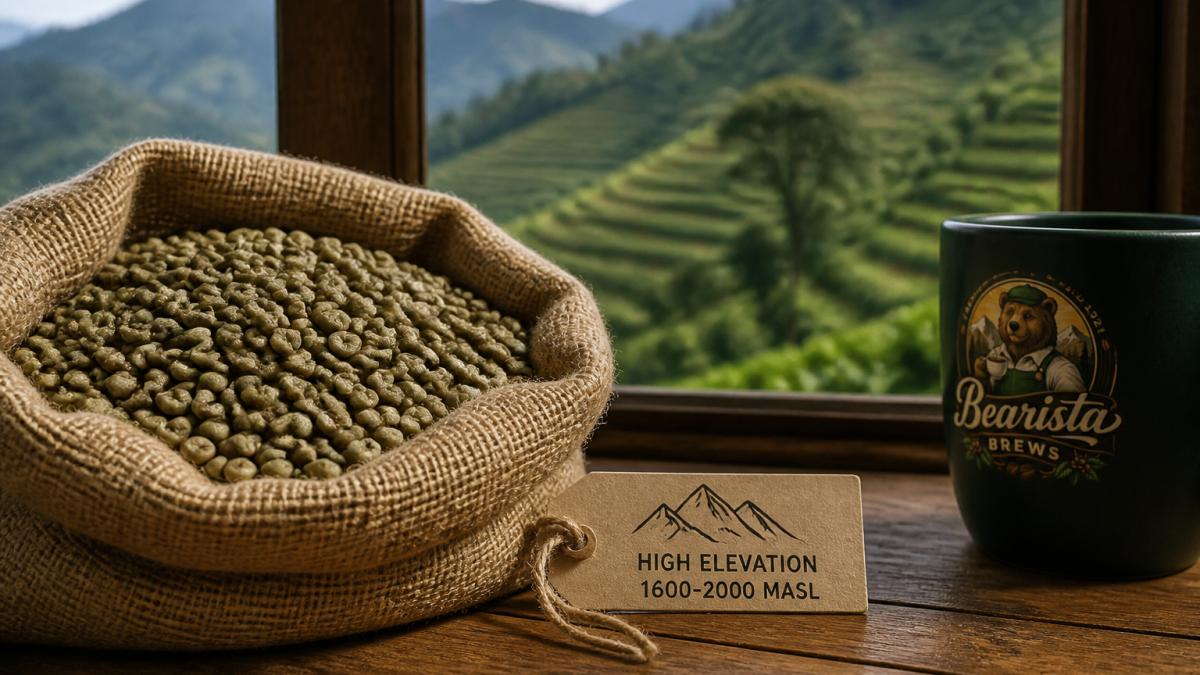
Our Kenya lot comes from Othaya in Nyeri County, where SL28 and SL34 varieties grow between 1,700 and 1,890 meters and are fully washed and dried on raised beds.

How to Read a Verified Altitude Range
A verified altitude range is the measured band, in meters above sea level, where a specific lot was grown, confirmed by the importer or cooperative rather than estimated by the roaster.
When a bag says "1,300-1,700M," that means the contributing farms sit across that band. Ask yourself three things: is the range narrow enough to mean something, does the origin match the flavor you want, and is the roast level suited to your brewer.
Freshly Roasted Specialty Coffee Beans: Why Roast Date Beats Everything Else
A roast date is the single most useful number on a coffee bag, and it matters more than elevation once the bean is in your kitchen.
This is where we put our money.
Storage matters too. Keep beans whole in an airtight container away from light and heat, grind right before brewing, and finish the bag within a few weeks of opening.
How We Scored These Beans: Elevation, Freshness, and Cupping Notes
We scored each lot on four weighted criteria: verified growing elevation, time from roast to ship, cupping clarity, and how well the bean performs across brewing methods.
Cupping notes came from our own tasting, recorded against the SCA's descriptive vocabulary for acidity, sweetness, body, and clean cup. We did not score packaging or price into the ranking, since every bag in this lineup sits at the same $23.99, which removes cost as a differentiator.
Brewing High-Grown Coffee by Method: Espresso, Pour-Over, and Milk Drinks
Match the bean to the brewer and the cup improves immediately. High-grown coffee is not one-size-fits-all, and dense high-grown beans behave differently from softer low-grown coffee: they resist extraction, so they usually want a slightly finer grind or a little more contact time than the same roast from a lower farm.

The starting recipes below are deliberately conservative. Adjust grind first, then dose, then water temperature, changing one variable at a time is the fastest way to learn what a bean wants.
Espresso and Milk Drinks
- Beans: Honduras, Guatemala, and Colombia. Their caramel, chocolate, and brown sugar notes hold up under pressure and cut through milk.
- Dose: start around 18 g in a double basket.
- Yield and time: aim for roughly 36 g out in 27-32 seconds. If the shot runs fast and tastes sharp, grind finer; if it chokes and tastes bitter, grind coarser.
Pour-Over and Filter
- Beans: Kenya, Ethiopia Natural, and Tanzania. Bright acidity and floral aromatics shine when water passes slowly through a paper filter.
- Ratio: start at about 1:16 coffee to water (for example, 20 g coffee to 320 g water).
- Water: just off the boil, roughly 93-96°C. High-grown beans are dense and extract a little slower, so keep the water hot rather than cool.
Drip and Batch Brew
- Beans: Peru, Costa Rica, and Guatemala. Balanced sweetness and clean finishes survive a longer brew cycle.
- Ratio: about 1:17 coffee to water.
- Grind: medium, matched to your machine's basket. A longer brew cycle rewards a slightly coarser grind than pour-over.
Cold Brew
- Beans: Kenya works well here; its orange and citrus notes stay lively even at low extraction temperatures.
- Ratio: roughly 1:8 coffee to water by weight for concentrate.
- Time: 14-18 hours in the refrigerator, then dilute to taste.
Single-Serve
Peru Coffee Pods deliver the same salted-caramel, citrus profile without grinding, which makes them the low-effort entry point if you are not ready to dial in a recipe.
Specialty Coffee Association's brewing guidance recommends a grind size matched to contact time, which is why the same bean can taste sharp in an espresso machine and sweet in a pour-over.
Choosing Your Bag: A Decision Framework Before You Check Out
Run this checklist before you add anything to your cart. It takes about a minute and saves you from a bag you won't finish.
- Pick your flavor direction. Bright and fruity points to Kenya, Ethiopia Natural, or Tanzania. Sweet and rounded points to Peru, Costa Rica, or Guatemala.
- Confirm your brewer. Espresso machine or milk drinks: Honduras, Colombia, Guatemala. Pour-over or filter: Kenya, Ethiopia Natural, Tanzania.
- Check the roast date. Anything roasted within the last two weeks is ideal.
- Verify the elevation range. A specific band in meters beats a vague "high grown" claim.
If you want a starting point rather than a research project, our Peru is the most approachable entry at $23.99, and our Kenya is the pick for anyone chasing a bright, citrus-forward cup.
Frequently Asked Questions
What makes high elevation coffee beans different?
Cool mountain air slows cherry ripening, so the bean has more time to develop sugars and density before harvest. Denser beans roast more evenly and hold more acidity and aroma. That is why high elevation coffee tends to taste brighter and more layered than low-grown coffee. The effect is real but not unlimited: past roughly 2,000 metres above sea level, frost and low yields start working against quality. Elevation is one signal, not a guarantee, so check the roast date and processing method too.
Does coffee grown at higher elevations taste better?
Higher growing elevation usually means slower ripening, denser beans, and a brighter cup with more sweetness and flavor complexity. Kenya from 1,700-1,890 metres and Ethiopia Natural from 1,700-1,900 metres show that clearly, with citrus, floral, and fruity notes. But a well-processed 1,300-metre Colombian can beat a poorly handled 1,800-metre lot. Treat elevation as one filter among several, alongside processing, variety, and how recently it was roasted.
How can I tell if coffee beans are specialty grade?
Specialty coffee is graded on a 100-point scale by a licensed cupper, and specialty lots score 80 or above. In practice, look for a stated origin down to the region or cooperative, a named variety, a processing method, and a verified altitude range in metres above sea level. A roast date matters as much as the score, because green coffee quality fades once roasted. Bearista Brews roasts every order individually and ships within 2-3 days, so the bag arrives close to peak.
How should I brew high elevation specialty coffee?
Bright, dense high-grown beans reward control. For pour-over, use water at 92-94°C with a medium-fine grind and a 1:16 ratio to protect the acidity. For espresso, expect dense beans to resist extraction, so grind slightly finer and keep the ratio near 1:2 in 25-30 seconds. Medium-dark lots like Honduras from 1,300-1,700 metres hold up in milk-based beverages, while Kenya and Tanzania show best black. Adjust grind before changing dose.
Where can I buy freshly roasted high elevation coffee beans?
Buy from a roaster that lists the roast date, the verified growing elevation, and the processing method on the product page. Bearista Brews sells ten single origin high elevation coffees at $23.99 per bag, plus Peru Coffee Pods at $19.99, and roasts to order so bags ship within 2-3 days. Start with Kenya or Ethiopia Natural for brightness, Guatemala for balance, or Honduras for a medium-dark cup that works in milk.
The hard part isn't finding high elevation coffee. It's finding a bag that was still fresh when it reached you, roasted with enough care that the altitude actually shows up in the cup. Bearista Brews sources specialty-grade beans from high-elevation estates, roasts each order individually with our Flame-Tuned process, and ships within 2 to 3 days of roasting so peak aroma survives the trip. Find your perfect roast and taste what verified altitude plus real freshness does for your morning.